When implementing or further developing SAP Extended Warehouse Management, one key question arises early on: which architecture model is the right fit?
Single-tier, two-tier, and hybrid architectures describe different ways in which SAP EWM is embedded and operated within the existing SAP system landscape.
The choice of architecture model has a direct impact on system landscape, integration, operations, scalability, and governance of logistics IT.
This page provides a structured positioning of the three models and outlines under which conditions each approach is appropriate.
The architecture models single-tier, two-tier, and hybrid exclusively describe the technical arrangement and system coupling of ERP, warehouse management, and related logistics systems.
The functional scope of SAP EWM remains unchanged and is not dependent on the architecture model.
Regardless of this, SAP EWM can be operated either as embedded SAP EWM within SAP S/4HANA or as decentralized SAP EWM in a separate system. Both operating variants can be realized within different architecture models, depending on the overall setup.
A more detailed view of the technical implementations can be found on the dedicated pages for embedded SAP EWM, decentralized SAP EWM, and the direct comparison of both approaches.
In embedded SAP EWM, warehouse management is operated directly within SAP S/4HANA. Integration is achieved without a separate system, enabling tight coupling of logistics processes.
In decentralized SAP EWM, warehouse management runs as an independent SAP system and is integrated with SAP ERP or SAP S/4HANA via standardized interfaces.
This model offers a clear separation of systems and is particularly suited for high-performance or automated warehouse environments.
Embedded and decentralized SAP EWM differ in system architecture, integration approach, and operational setup.
A direct comparison supports the structured evaluation of strengths and use cases.
In a single-tier architecture, SAP EWM is fully integrated into SAP S/4HANA. ERP and warehouse processes run within a shared system and access a unified data model.
Material movements, inventory, and logistics documents are processed without crossing system boundaries. Separate interfaces between ERP and warehouse management are not required.
Single-tier architecture is characterized by a lean system landscape and tight process integration. Integration effort and architectural complexity remain low, and operations and maintenance are comparatively straightforward.
This model is particularly suitable for warehouses with low to medium process complexity, where transparency, stability, and manageable operational effort are key priorities.
In a two-tier architecture, SAP EWM operates as an independent system and is integrated with SAP ERP or SAP S/4HANA via standardized interfaces.
ERP and warehouse management are technically separated but remain process-integrated. Communication is typically handled asynchronously or event-driven through clearly defined integration scenarios.
The clear system separation enables independent scaling, maintenance, and further development of the warehouse management system. At the same time, additional integration and operational effort is required.
Two-tier architecture is often used in high-performance logistics environments, such as high-throughput warehouses, highly automated facilities, or 24/7 operations.
Hybrid architectures combine elements of single-tier and two-tier models. Typically, embedded SAP EWM is used for standardized warehouse processes, while selected sites or warehouse areas are connected via decentralized SAP EWM.
Hybrid models enable a differentiated architecture aligned with specific logistics requirements. However, they also increase overall complexity, particularly in terms of governance, operations, and responsibilities.
Hybrid architectures are particularly suitable for heterogeneous logistics landscapes, such as international organizations or system landscapes that have evolved over time.
The right SAP EWM architecture model results from process requirements, scalability needs, and governance considerations – not from functional scope alone.
Single-tier, two-tier, and hybrid models differ in system coupling and operational setup, not in the functional capabilities of SAP EWM.
Single-tier architectures have a reduced system landscape with lower integration effort. Two-tier and hybrid models require a clearly defined integration architecture but offer greater flexibility in system design and process decoupling.
Single-tier architectures simplify operations and maintenance. Two-tier models enable decoupled maintenance windows and release cycles between ERP and warehouse management. Hybrid models require clearly defined operating and responsibility models.
Single-tier architectures are limited by the overall system capacity. Two-tier and hybrid models offer greater flexibility, especially in scenarios with increasing throughput or higher levels of automation.
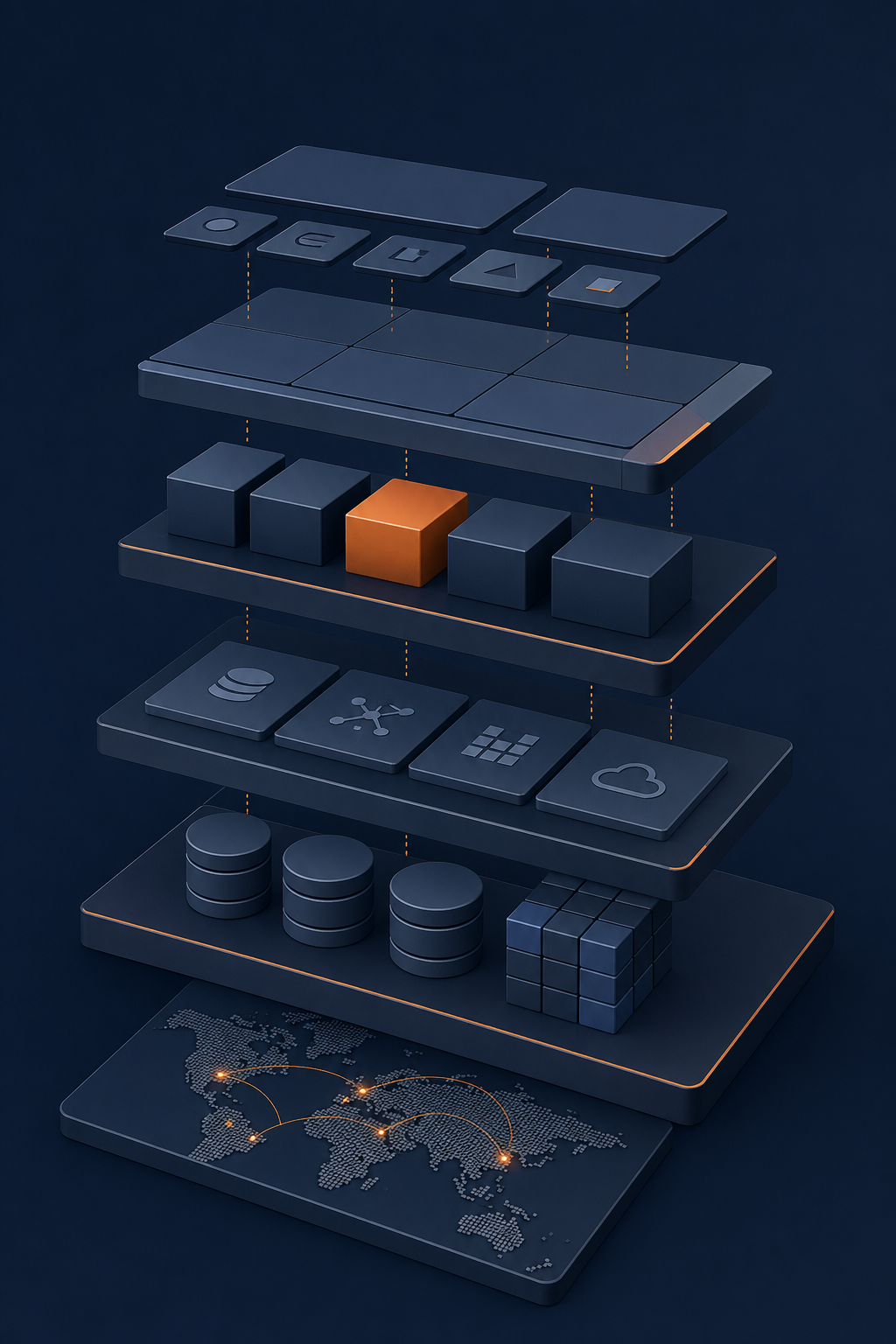
The selection of the SAP EWM architecture model impacts both logistics performance and the stability and future readiness of the IT landscape.
While logistics requirements such as throughput, automation, and operating models are key drivers, IT considerations such as system complexity, maintainability, and integration effort are equally critical.
A robust architecture decision therefore typically emerges from the interaction between logistics, IT, and overall business strategy.
The choice of the appropriate SAP EWM architecture model is a strategic decision with long-term impact on logistics performance, IT stability, and investment security.
The following questions address typical decision points at management and architecture level.
Not always. In many cases, evaluating architecture options in a structured way before making irreversible design or implementation decisions is the main value.
Yes, within the SAP ecosystem. Recommendations are based on processes, scalability, and future requirements – not on tool-specific preferences or licensing considerations.
No. Especially in brownfield scenarios, migrations, or existing landscapes, a structured architecture decision improves transparency and reduces project risk.
The focus is on providing a sound decision basis. The results are strategically grounded but sufficiently concrete to be transferred into design and implementation phases.
No. The objective is to ensure decision clarity based on transparent pros and cons – not to enforce a predefined model.
As soon as SAP EWM becomes strategically relevant – not only once the project has already started.
We support companies in positioning single-tier, two-tier, and hybrid architectures within their individual logistics and IT strategy.
The goal is not a standard recommendation, but a sustainable architecture decision aligned with performance, scalability, and future requirements.
Discover the latest analyses, articles, and perspectives on SAP, supply chain, and business transformation. Practical knowledge – directly from our consultants for your business.