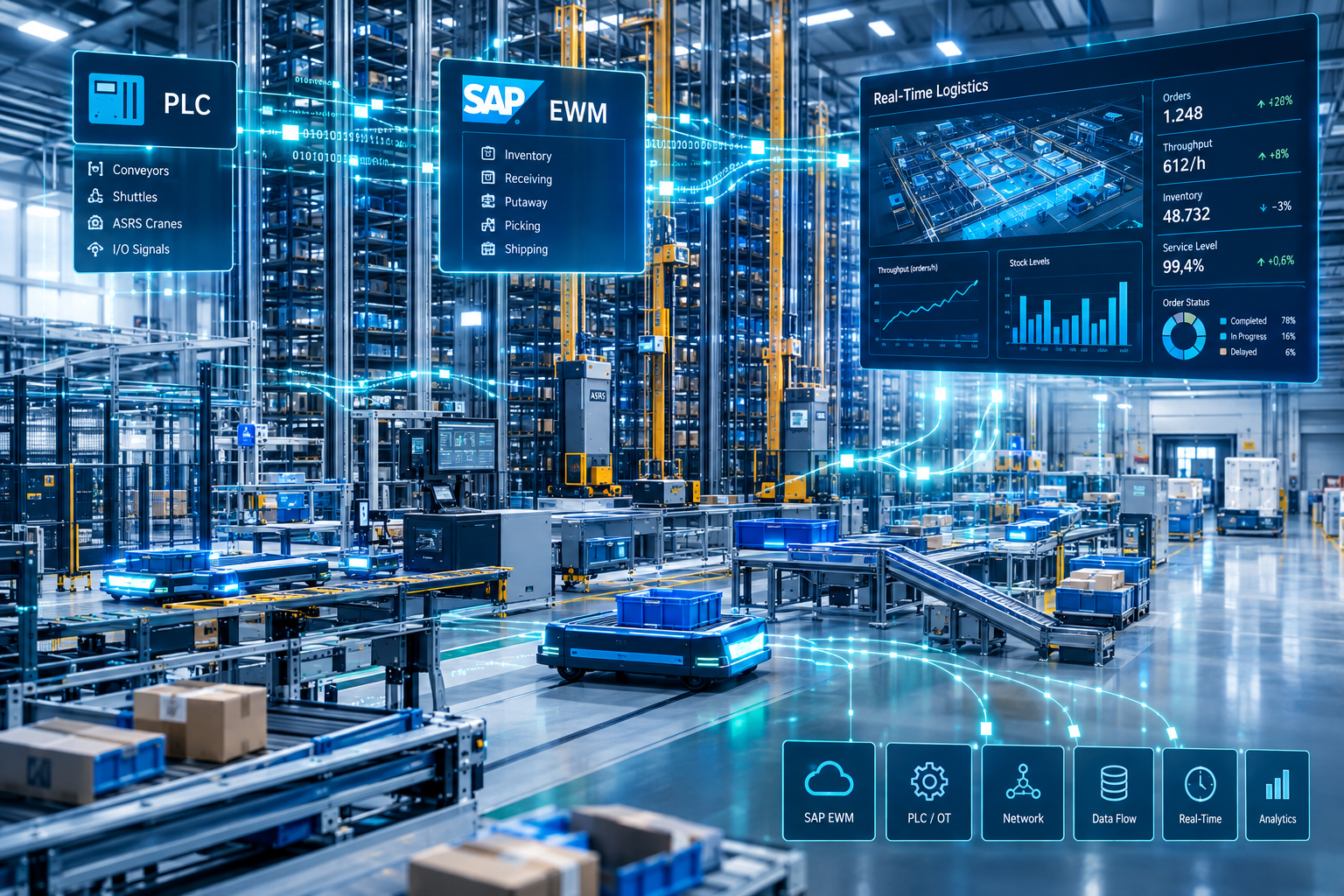
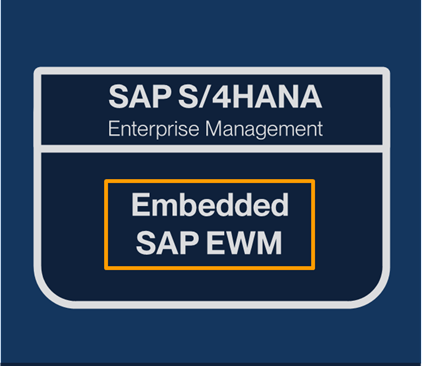
Embedded SAP Extended Warehouse Management (SAP EWM) describes an operating model in which the warehouse management system is directly integrated into SAP S/4HANA.
The warehouse management system is not operated as a separate system but is part of the same system architecture and database as the ERP.
Embedded SAP EWM is typically used when tight process integration between ERP and warehouse processes is required and a lean system landscape is intended.
The actual functional scope depends on the selected functional variant (Basic vs. Advanced) as well as the chosen cloud and deployment model.
Embedded SAP EWM is not a standalone product, but an architecture and integration variant of SAP EWM within SAP S/4HANA.
A key characteristic is the shared use of a single SAP S/4HANA system for both ERP and warehouse processes. ERP and EWM operate on a unified data model, ensuring that master data, documents, and transactional data are maintained consistently within one system instance.
Embedded SAP EWM can be operated both on-premise and in SAP S/4HANA Cloud, Private Edition.
EWM functionality is also available in the Public Cloud, but with functional limitations compared to on-premise and private cloud scenarios.
Embedded SAP EWM is often selected when a central SAP S/4HANA system is operated or planned and warehouse processes are closely integrated with production, procurement, or distribution processes.
Organizations that aim for a manageable system landscape and do not require strict organizational or technical separation between ERP and warehouse management benefit particularly from this approach.
Typical use cases include production sites, distribution centers with moderate process complexity, and companies with clearly defined end-to-end process requirements.
ERP and warehouse processes interact seamlessly within one system. Media breaks and synchronization efforts are avoided.
A unified system landscape reduces operational, maintenance, and integration efforts.
Master data, documents, and transactional data are managed centrally, improving transparency and data quality.
Embedded SAP EWM is fully aligned with the SAP S/4HANA strategy and designed for long-term use.
Embedded SAP EWM offers tight integration and a lean architecture. At the same time, this approach introduces specific constraints that should be considered when making architecture decisions. A structured assessment helps avoid later limitations.
In scenarios with very high throughput or highly automated environments, the shared use of a single system for ERP and warehouse processes can result in increased system load. In such cases, performance, scalability, and load distribution become critical factors.
Since ERP and warehouse processes run within the same system architecture, maintenance activities, release changes, or system interventions affect both areas simultaneously. Temporal or organizational decoupling is only possible to a limited extent.
In globalen oder stark heterogenen IT‑Landschaften kann Embedded SAP EWM an Grenzen stoßen – etwa bei unterschiedlichen regionalen Anforderungen oder separaten Betriebsmodellen. In solchen Fällen bieten dezentrale oder hybride Architekturen häufig mehr Flexibilität.
Embedded SAP EWM must be clearly distinguished from decentralized SAP EWM, where warehouse management is operated as an independent system, and from hybrid architectures that combine different operating and deployment models.
A structured comparison of these approaches is available on the corresponding comparison page.
For IT decision-makers, the architecture decision is key: system complexity, operating model, and long-term maintainability are primary considerations.
For logistics decision-makers, the focus is on whether warehouse requirements can be fully supported and how closely operational processes are integrated with adjacent business areas.
Embedded SAP EWM often provides a solid baseline, but requires a structured evaluation within the context of specific logistical, organizational, and technical conditions.
The decision in favor of embedded SAP EWM should be based on a clear evaluation of processes, system landscape, and future requirements.A structured initial assessment can provide guidance – for example regarding architecture variants, cloud options, and the fundamental operational setup of warehouse logistics.
Have questions? In the following FAQs, we have compiled the most important answers for you. If your question is not included, please feel free to contact us directly.
Embedded SAP EWM refers to operating SAP EWM directly within an SAP S/4HANA system without a separate EWM instance.
No. The functional capabilities of SAP EWM are generally identical. Differences arise from architecture, operations, and scalability rather than from core functionality.
Yes. Embedded SAP EWM can be operated on-premise as well as in SAP S/4HANA Private Cloud Edition. In the Public Cloud, functionality is available in a limited form.
A decentralized setup can offer advantages in scenarios with very high throughput, complex automation, or when clear separation between ERP and warehouse operations is required.
For organizations operating an integrated, low-maintenance logistics setup with moderate complexity and clearly defined processes.
Operations are simplified as only one system landscape needs to be managed. However, maintenance windows typically affect both ERP and warehouse operations simultaneously.
Discover the latest analyses, articles, and perspectives on SAP, supply chain, and business transformation. Practical knowledge – directly from our consultants for your business.