Core ERP functions, positioning and clear boundaries to SAP EWM
SAP S/4HANA is the digital core system for enterprise processes. In warehouse management, the ERP provides fundamental capabilities.
However, in more complex warehouse, throughput or automation scenarios, the ERP standard clearly reaches its limits.
This page positions SAP S/4HANA deliberately in the context of warehouse management and shows when SAP EWM – especially embedded EWM – is the right choice.
SAP S/4HANA forms the central ERP core for enterprise data and business processes.
In a warehouse context, S/4HANA primarily covers:
Historically, warehouse processes were managed within ERP using SAP WM (LE-WM).
With S/4HANA, SAP clearly separates responsibilities:
This separation is essential for a future-proof warehouse architecture.
SAP S/4HANA provides basic warehouse functionality directly within the ERP system.
These are particularly suitable for:
Typical limitations of the ERP standard include:
These limitations are not a drawback, but rather reflect the clear role separation between SAP ERP and SAP EWM.
SAP EWM is an integral part of SAP S/4HANA and can be deployed directly within the ERP system as embedded EWM.
This means:
Embedded SAP EWM provides:
Embedded EWM is not a “light version” of EWM, but the recommended architecture for many modern SAP warehouse scenarios.
This distinction is essential for making future-proof system decisions.
Legend:
✅ = Suitable / fully supported
⚠️ = Limited suitability depending on Scenario
❌ = Not supported / not intended
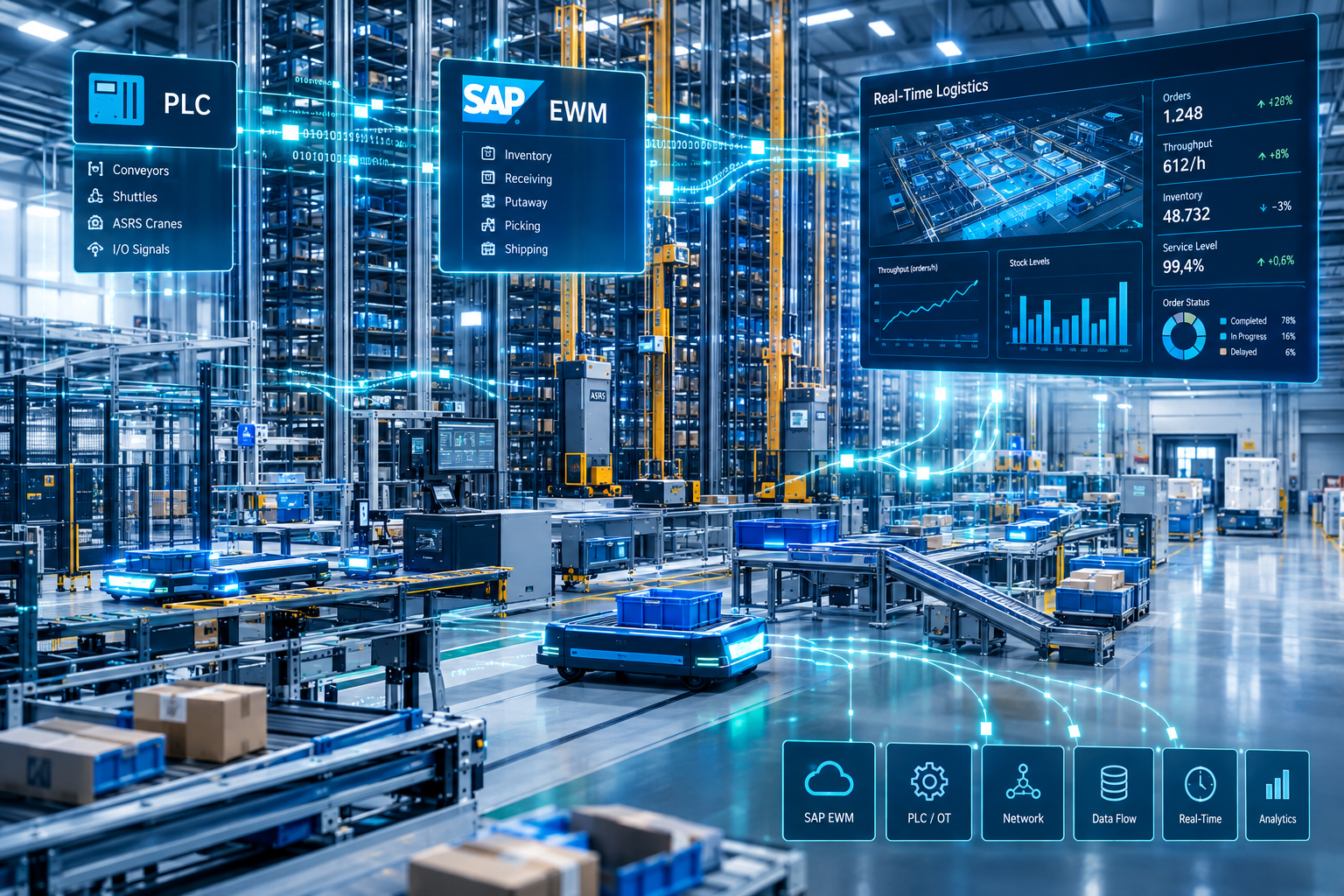
SAP S/4HANA, SAP EWM and SAP warehouse automation solutions do not represent an either-or choice – they form a clearly structured, layered overall concept:
Qinlox supports you in positioning, architectural decision-making and the implementation of this overall landscape.
SAP S/4HANA provides the foundation – SAP EWM executes warehouse operations.
For complex, high-performance or automated environments, SAP EWM is essential.

Wir beraten bei der Einordnung von SAP S/4HANA und SAP EWM, der Wahl zwischen Embedded‑ und dezentralen Architekturen sowie der Vorbereitung auf Automatisierung und MFS.
Do you have questions? In the following FAQs, we have compiled the most important answers for you. If your question is not covered, feel free to contact us directly.
SAP S/4HANA provides basic warehouse functionality within the ERP core, including inventory management and simple processes. For complex warehouse structures, high throughput, automation or material flow control, SAP EWM is required.
SAP S/4HANA is suitable for simple, low-complexity warehouse setups. As soon as requirements such as performance, process complexity, automation or MFS arise, SAP EWM becomes the recommended solution.
Embedded SAP EWM is fully integrated into SAP S/4HANA and runs within the same system. It combines ERP and advanced warehouse functionality without requiring a separate system landscape.
No. Depending on the license and edition, embedded EWM provides the full EWM functionality, including support for automation, MFS and robotics. It is not a reduced version.
No. SAP follows a clear separation: S/4HANA remains the ERP core, while SAP EWM handles advanced warehouse execution. Both systems complement each other.
Qinlox supports the positioning of SAP S/4HANA and SAP EWM, the selection of suitable architectures (embedded or decentralized), and the preparation for automation and material flow control.
Explore current analyses, articles and practical insights on SAP, supply chain execution and enterprise transformation – directly from our experts.