
More Transparency and Control in Returns Management with SAP EWM
Returns are an integral part of daily logistics operations today – in B2B as well as in B2C environments. SAP EWM supports returns with system‑guided process steps, from goods receipt and inspection through to decisions on restocking, rework, or disposal. Through integration with SAP ERP and optional QM functions, a transparent, traceable, and efficiently controllable returns process is created.

Customer Return
Customers return goods, for example due to damage, incorrect deliveries, or dissatisfaction. The return is initiated in the SAP ERP system and transferred to SAP EWM, where the goods are recorded, inspected, and further processed.
Vendor Return
Defective or excess goods are returned to the supplier. SAP EWM supports identification, stock transfer postings, and system‑guided goods issue processing.
Internal Return
Returns from internal branches or production are re‑posted into the warehouse and evaluated – forming the basis for decisions on rework, restocking, or disposal.
Why Returns must be well managed
Returns are part of everyday business for many companies – especially in retail, spare parts logistics, and wherever customer expectations regarding quality and delivery accuracy are high.
Increasing return volumes, rising process costs, and high transparency requirements demand clearly structured processes.
Efficient returns management is characterized by transparency, speed, and clearly defined inspection steps. SAP EWM provides exactly the standard functions required for this.
Challenges in Reality
In many warehouses, return processes are noticeably inconsistent:
- missing or incomplete return notifications
- unclear inspection steps or undefined stock types
- manual stock transfers and long dwell times
- media breaks between SAP ERP, warehouse operations, and quality management
- high clarification effort at goods receipt
The result: long lead times, increasing processing costs, and a process that often cannot cope with growing return volumes.
System‑Supported Transparency Throughout the Entire Returns Process
SAP EWM guides returns processes step by step and ensures that every return is correctly recorded, inspected, and further processed.
By integrating with SAP ERP, optional QM, and clearly defined follow‑up actions, a seamless, transparent, and efficiently controllable returns process is created – without additional tools or add‑ons.

SAP EWM in the Returns Process – Explained in Practice
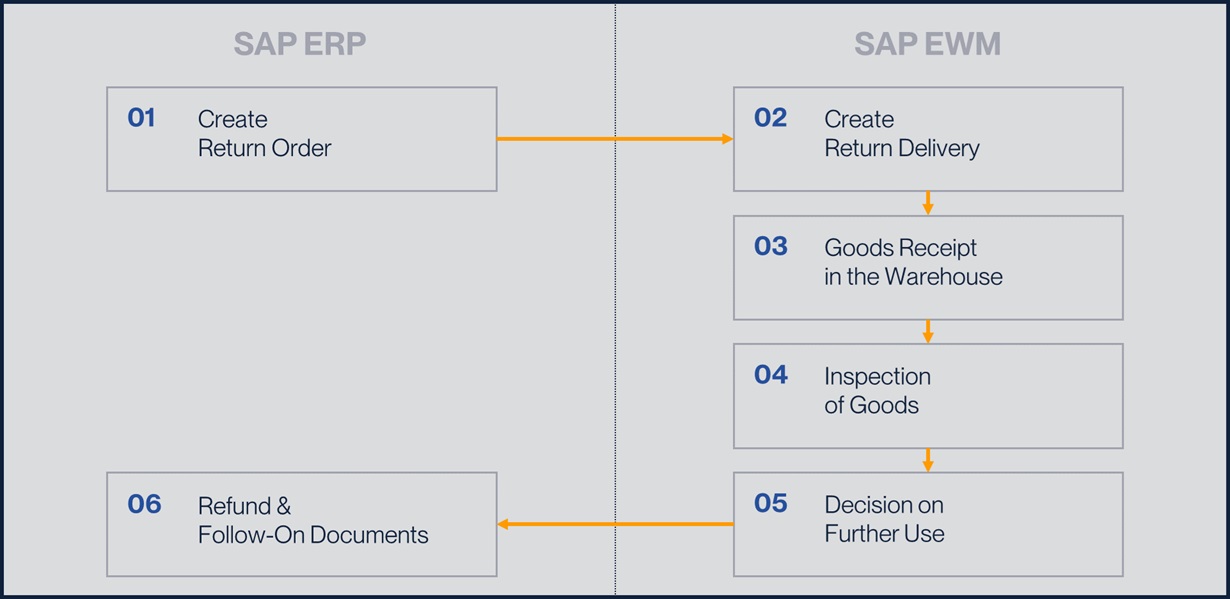
The returns process in SAP EWM can be mapped in a clearly structured way. The typical process includes:
1. Creation of the Return order
The process starts in SAP ERP – with or without reference to the original order. The return document controls integration with the warehouse.
2. Creation of the Return Delivery
The physical return is transferred to SAP EWM via a return delivery.
3. Goods Receipt in the Warehouse
SAP EWM posts the goods receipt and assigns the correct stock type, such as “returns stock”, “inspection stock”, or “blocked stock”.
4. Inspection of the Goods
Inspection is a central step. The following aspects are evaluated:
- undamaged and reusable goods
- damaged items
- defective or incomplete goods
Optionally, quality inspection (QM/QIE) can be integrated.
5. Decision on Further Use
Based on the inspection, follow‑up actions are defined, for example:
- restocking
- rework or repair
- scrapping
- return to the supplier
6. Refund & Follow-Up Documents
In SAP ERP, credit memos, replacement deliveries, or internal postings are triggered – fully integrated with SAP EWM.
This clear structure ensures that every step remains traceable and significantly reduces manual clarification efforts.
Benefits of an SAP EWM-supported return process
Process Optimization
Standardized workflows, automated postings, and clear system guidance reduce manual effort and increase process quality.
Transparency & Monitoring
Real‑time status information, stock overviews, and optional inspection processes ensure a high level of visibility – from goods receipt to the final decision.
Increasing Efficiency
Automated stock type control and putaway determination shorten lead times and reduce process costs.
Conclusion on SAP EWM Returns Management
A cleanly integrated returns management process in SAP EWM is particularly worthwhile for companies with high return volumes, multiple return scenarios (customer, vendor, or internal returns), or complex warehouse structures. The process becomes more transparent, faster, and more cost‑efficient. Companies benefit from clearly defined inspection processes, stable inventory levels, and improved service quality.
FAQs
Returns management includes many individual steps that must work together smoothly in daily operations. The following questions and answers provide a concise overview of typical challenges, key process steps, and the most important functions with which SAP EWM supports returns processing in the warehouse.
Returns management describes the system‑supported processing of returned goods. SAP EWM controls receipt, inspection, stock management, and follow‑up actions such as restocking, rework, or disposal.
Customer returns, vendor returns, and internal returns.
Always in SAP ERP via a return order – with or without reference to the original order.
Via a return delivery that is posted in SAP EWM. Stock types such as returns stock, inspection stock, or blocked stock are assigned.
The goods are inspected with regard to condition, completeness, and reusability. Optional support is provided by quality inspection (QM/QIE).
SAP EWM accelerates returns processes through automated goods receipt postings, stock type control, and putaway determination. Process controls ensure that inspections, rework, or putaway are handled efficiently, reducing lead times and manual errors. At the same time, integration with ERP and optional QM enables end‑to‑end transparency so that all stakeholders are informed about the current return status at all times.
SAP EWM provides comprehensive functions for monitoring and analyzing returns processes. Real‑time dashboards, status messages, and reports enable tracking of return volumes, processing times, stock types, and process statuses. This allows bottlenecks, delays, or recurring errors to be identified quickly and optimized in a targeted manner, significantly increasing transparency and efficiency in returns management.