Automation of warehouse processes in the SAP EWM context – structured overview
Warehouse automation is no longer an isolated technology topic, but the result of process design, system architecture, and technical orchestration.
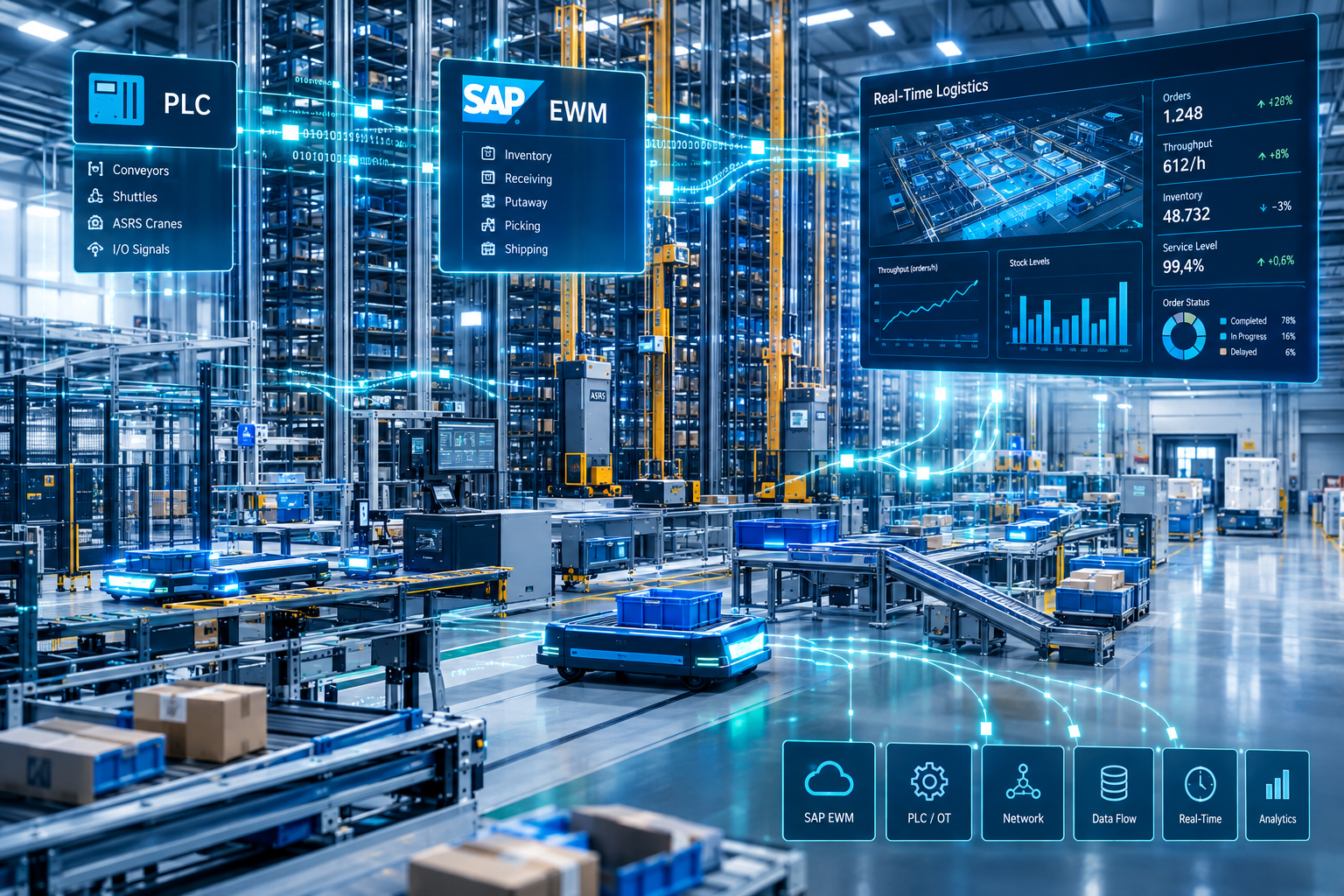
Within the SAP environment, SAP Extended Warehouse Management (SAP EWM) acts as the central control and decision-making layer for automated warehouse processes.
This overview structures the key building blocks of SAP warehouse automation and shows how material flow control, robotics, and Qinlox frameworks interact effectively.
SAP warehouse automation does not describe the mechanical aspects of conveyor technology or robotics itself, but rather the SAP-side control, orchestration, and safeguarding of automated material movements.
In the SAP environment, SAP Extended Warehouse Management (SAP EWM) takes the role of the process-leading and decision-making system.
Central decisions for controlling automated warehouse processes are made strategy-based directly within SAP EWM.
These strategies are defined within the SAP system and can leverage all process-relevant information for decision-making, including inventory levels, order priorities, process status, resources, downstream processes, as well as ERP and production context.
As a result, SAP EWM takes responsibility for:
By embedding decision and control logic within SAP EWM, all relevant process information is consistently available in real time. This represents a clear advantage over external control or WCS systems, which often rely on partial information and operate outside the full process context.
Automation in the SAP context is typically introduced step by step, modularly, and process-driven – depending on requirements, architecture, and target design.
SAP warehouse automation can be structured into clearly defined levels. These build on each other but are technologically and functionally distinct.
Material flow control represents the classical foundation of warehouse automation.
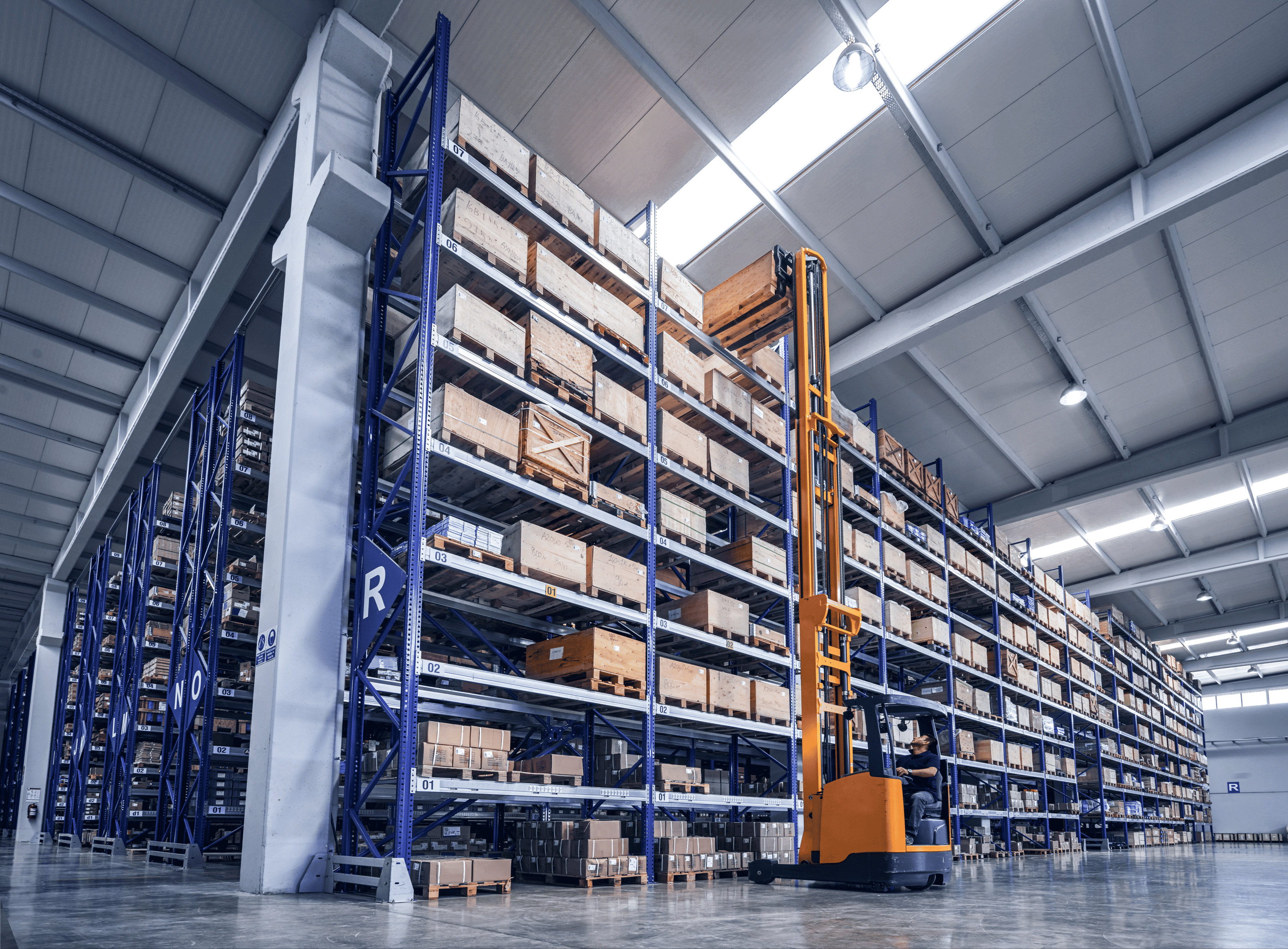
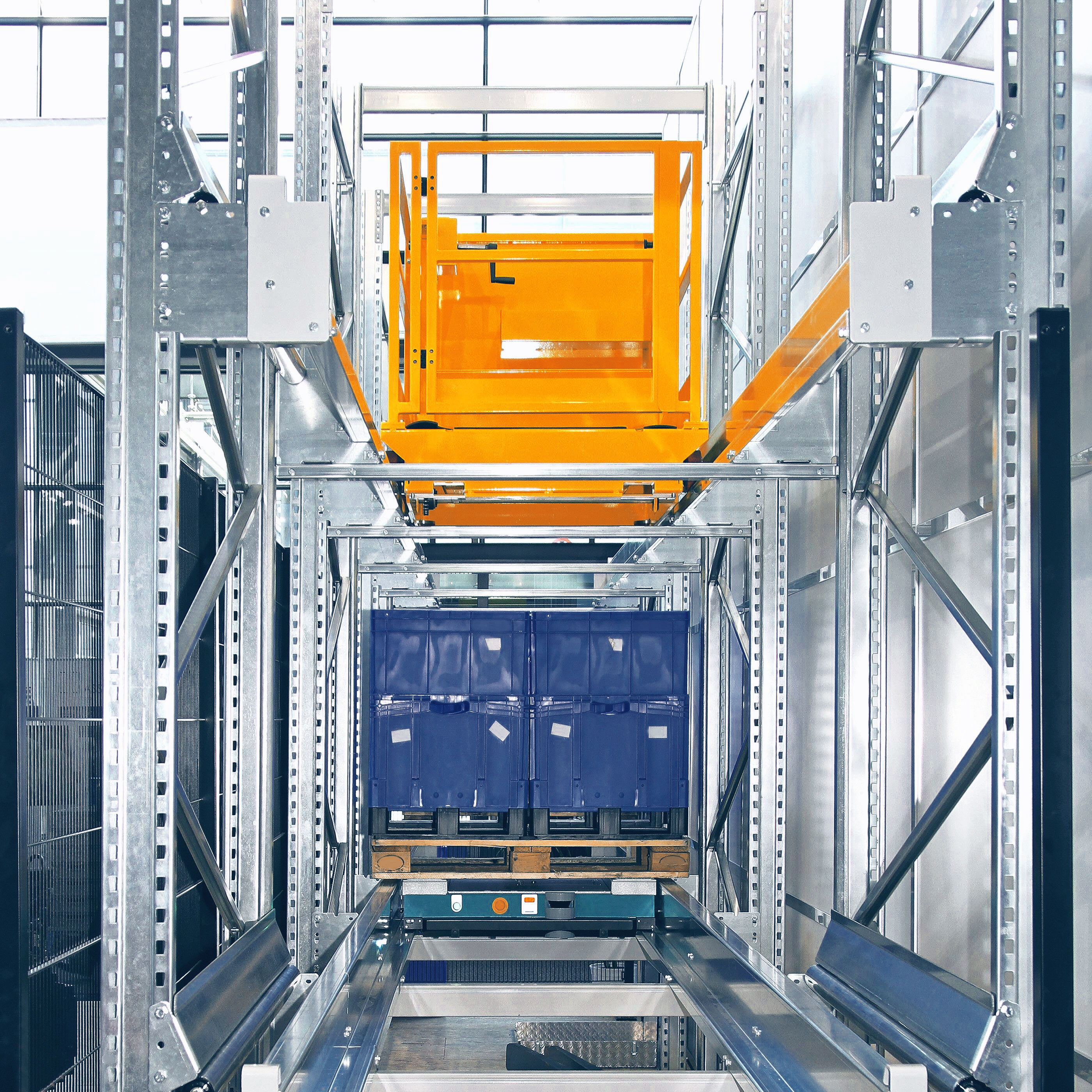
Automated conveyor systems, high-bay warehouses, shuttle systems, sorters, as well as connected lifts and transfer or packing stations are controlled directly from SAP EWM.
SAP EWM thus takes over the function of an integrated Warehouse Control System (WCS) – without additional middleware.
Typical application areas of this automation level include conveyor and sorting systems, high-bay and shuttle warehouses, as well as identification, transfer, and buffering points within automated warehouse structures.
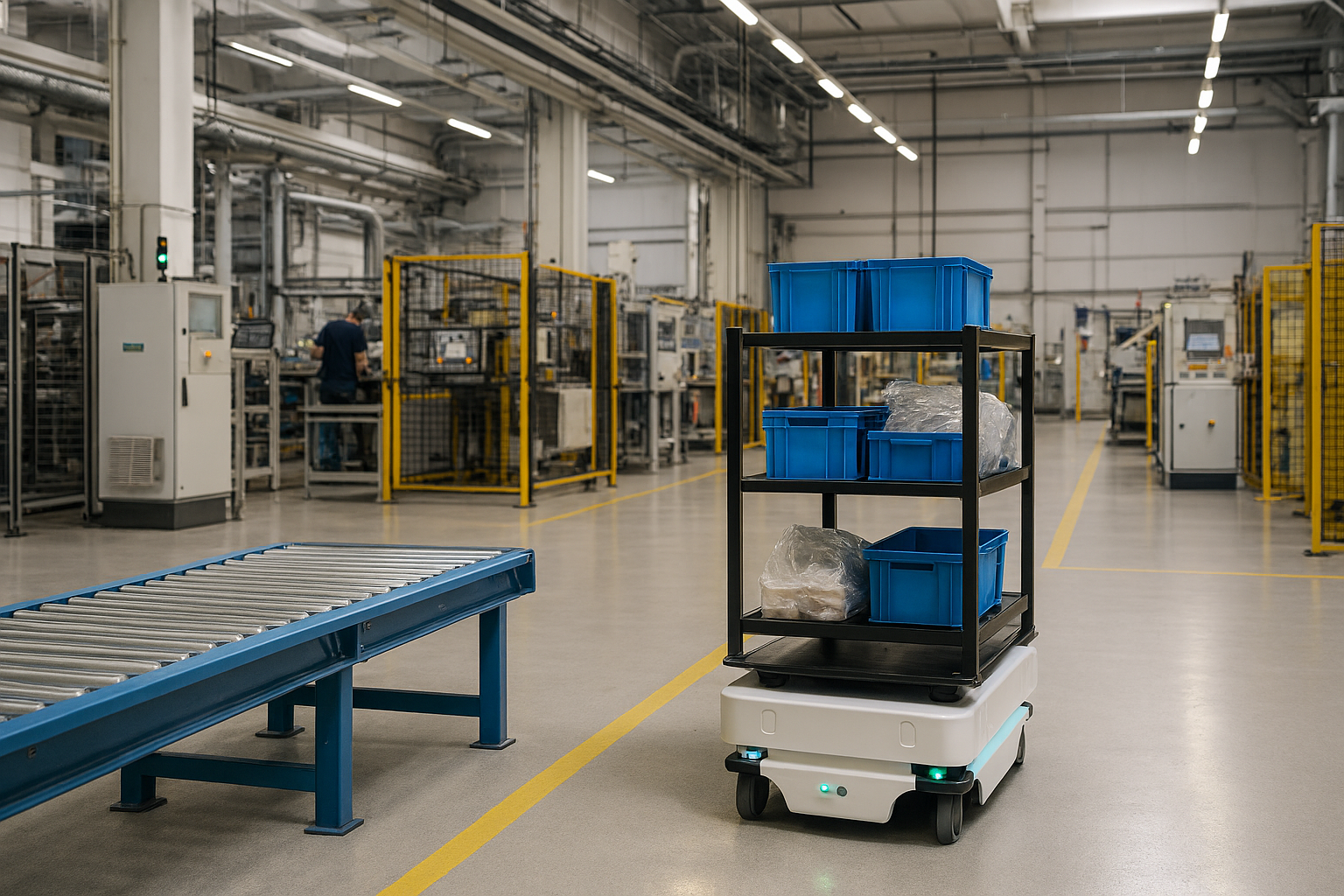
The second level addresses flexible, mobile automation, such as autonomous mobile robots (AMR) or automated guided vehicles (AGV).
With SAP Warehouse Robotics, robots are integrated as resources within SAP EWM and embedded into existing warehouse processes.
SAP EWM remains the leading process and decision-making system.
Typical use cases include transport and supply tasks within the warehouse, pick-assist scenarios, and the step-by-step automation of individual process areas.
In complex or highly automated warehouse environments, standard mechanisms are often not sufficient. In such cases, individual automation, testing, and simulation frameworks are used.
The Qinlox MFS & SIM framework extends SAP EWM with advanced control, testing, and simulation capabilities – especially for stabilizing complex automation scenarios.
The focus lies on controlled rollout, validation, and stabilization of complex material flow and automation concepts within a modular architecture.
Typical use cases include simulation of automated processes prior to go-live, advanced integration and control logic, as well as ensuring stability in high-performance or greenfield scenarios.
SAP warehouse automation is not about individual technologies, but about the right orchestration through SAP EWM.
Material flow control, robotics, and individual extensions only deliver value when aligned with architecture, processes, and system control.
The design of warehouse automation is closely linked to other fundamental decisions within the SAP EWM environment:
Automation should therefore never be considered in isolation, but always within the overall context of SAP logistics and IT architecture.
Typical objectives of SAP-based warehouse automation focus on improving performance, transparency, and scalability across logistics processes.
Organizations implement warehouse automation to:
Depending on the scenario, the focus may vary from stabilizing existing processes to enabling high-performance, fully automated logistics environments.
In all cases, automation is not an end in itself, but a means to achieve reliable, transparent, and scalable logistics operations. The specific objectives depend on the level of automation and the overall system architecture.
We support companies in the classification, evaluation, and design of SAP-based warehouse automation—from standard material flow control to complex high-performance and simulation scenarios.
Do you have questions? The following FAQs summarize the most important answers. If your question is not covered, feel free to reach out to us directly.
No. In practice, SAP-based warehouse automation is often introduced gradually. Many companies start by automating individual trades or process areas and then expand this step by step.
The key factor is not the level of automation itself, but the clean integration of automation within SAP EWM as the leading process system.
No. SAP EWM does not replace the mechanical components or control technology of the warehouse. Physical execution is still handled by conveyor systems, robotics, and PLC-based controls.
SAP EWM is responsible for the process-level orchestration of automated warehouse movements – including strategies, the creation and control of transport tasks, and the handling of exceptions and disruptions.
SAP EWM material flow control is particularly suitable for stationary, high-performance automation, such as conveyor systems, sorting systems, or high-bay warehouses.
SAP Warehouse Robotics, on the other hand, focuses on flexible, mobile automation, such as autonomous mobile robots (AMR), and is often used as a complement.
Both approaches are not mutually exclusive, but are frequently combined in modern warehouse architectures.
No. SAP-based automation can be implemented in both embedded and decentralized SAP EWM architectures. However, the chosen architecture influences how scalable, decoupled, and high-performance the automation setup can be designed.
Ideally, automation should be considered early. Even if automation is implemented at a later stage, architectural and process decisions should already take it into account from the beginning. Retrofitting automation into an existing setup is usually significantly more effort-intensive.
In many scenarios, yes. With SAP EWM MFS, material flow control is implemented directly within the SAP system, eliminating the need for a separate WCS solution. SAP EWM communicates directly with the PLC layer and integrates control and decision logic into the SAP process context.
Entdecken Sie aktuelle Analysen, Artikel und Impulse zu SAP, Supply Chain und Unternehmenstransformation. Praxisnahes Wissen – direkt von unseren Berater:innen für Ihr Business.