Understanding Functional Scope – and Selecting the Right Variant in the Right Context
SAP Extended Warehouse Management (SAP EWM) is available in two functional and licensing variants: Basic and Advanced.
Both variants are based on the same EWM code line, but differ significantly in the scope of supported functions.
This page positions SAP EWM Basic and Advanced and answers the key question: Which functions are available – and in which context are they relevant?
The distinction between SAP EWM Basic and SAP EWM Advanced relates exclusively to the functional scope and licensing of embedded SAP EWM within SAP S/4HANA.
Important for positioning:
Basic and Advanced do not represent different systems, but different functional configurations of SAP EWM.
SAP EWM Basic provides fundamental warehouse management capabilities that are sufficient for many standardized warehouse and production logistics scenarios.
SAP EWM Basic enables structured warehouse execution without advanced optimization or automation logic.
SAP EWM Advanced extends the Basic functionality with a wide range of capabilities for optimizing, controlling, and automating warehouse processes.
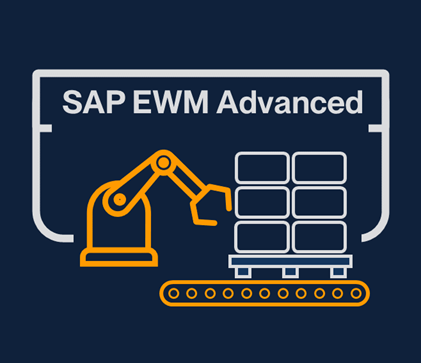
SAP EWM Advanced enables modeling of high-performance, highly automated, and dynamic logistics processes.
The choice between Basic and Advanced should not be driven by a simple feature comparison, but by the actual operational context.
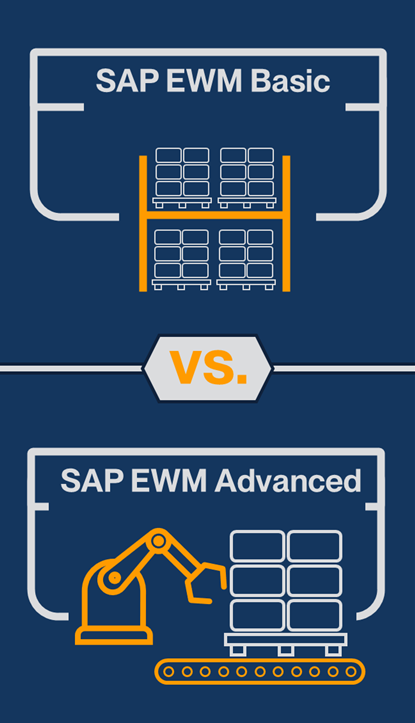
The functional scope (Basic vs. Advanced) represents an independent decision dimension within the SAP EWM architecture.
It is closely related to:
A well-founded SAP EWM decision takes all of these dimensions into account together.
SAP EWM Basic is suitable for standardized warehouse processes with limited complexity.
SAP EWM Advanced becomes necessary when functional depth, automation, or scalability are key requirements.

SAP EWM Basic and SAP EWM Advanced are not competing models, but context-specific functional variants designed for different requirements.
The right choice depends less on the current system landscape and more on process complexity, the level of automation, and the strategic development of logistics.
The overview and comparison pages support a structured positioning of SAP EWM capabilities.
Do you have questions about SAP EWM functional scope?
The following FAQs help position the differences between SAP EWM Basic and SAP EWM Advanced in a structured way. The focus lies on functional differences, typical boundaries of use, and the question of when the Advanced variant becomes necessary.
The difference between Basic and Advanced lies in functional scope and the licensing-related usage context. Both variants are based on SAP EWM, but they address different requirements. Basic covers fundamental and structured warehouse processes, whereas Advanced provides additional functionality for optimization, control, and automation.
Yes. For many standardized warehouse environments, SAP EWM Basic can be fully sufficient. This is particularly true when processes are clearly structured, extensive automation is not required, and the focus is on stable and transparent warehouse execution rather than highly dynamic process control. Basic should therefore not be seen as “too limited” in general, but as a deliberately suitable option for many scenarios.
SAP EWM Advanced becomes necessary when greater functional depth, automation, complex process logic, or additional optimization mechanisms are required. This includes, for example, MFS-related scenarios, advanced outbound control, more sophisticated resource usage, or specialized warehouse and distribution structures. As soon as the standard framework of Basic is no longer sufficient, Advanced becomes relevant.
No. SAP EWM Material Flow Control (MFS) is not part of SAP EWM Basic. MFS requires the Advanced variant. Companies that want to control stationary automation directly from SAP EWM therefore need to consider this early as part of licensing and solution design.
No, not in the same way. The Basic vs. Advanced distinction applies to the functional setup of embedded SAP EWM within the SAP S/4HANA context. In decentralized SAP EWM, the Advanced functional scope is effectively the relevant model. This means that the question “Basic or Advanced?” is mainly important in embedded scenarios.
In principle, yes. A later move is possible if requirements, automation level, or process complexity evolve over time. However, that potential evolution should ideally be considered early from both an architectural and functional perspective so that later expansion does not become unnecessarily complex. The decision should therefore not be based only on current requirements, but also on the long-term target state of logistics operations.
Discover the latest analyses, articles, and perspectives on SAP, supply chain, and business transformation. Practical knowledge – directly from our consultants for your business.